
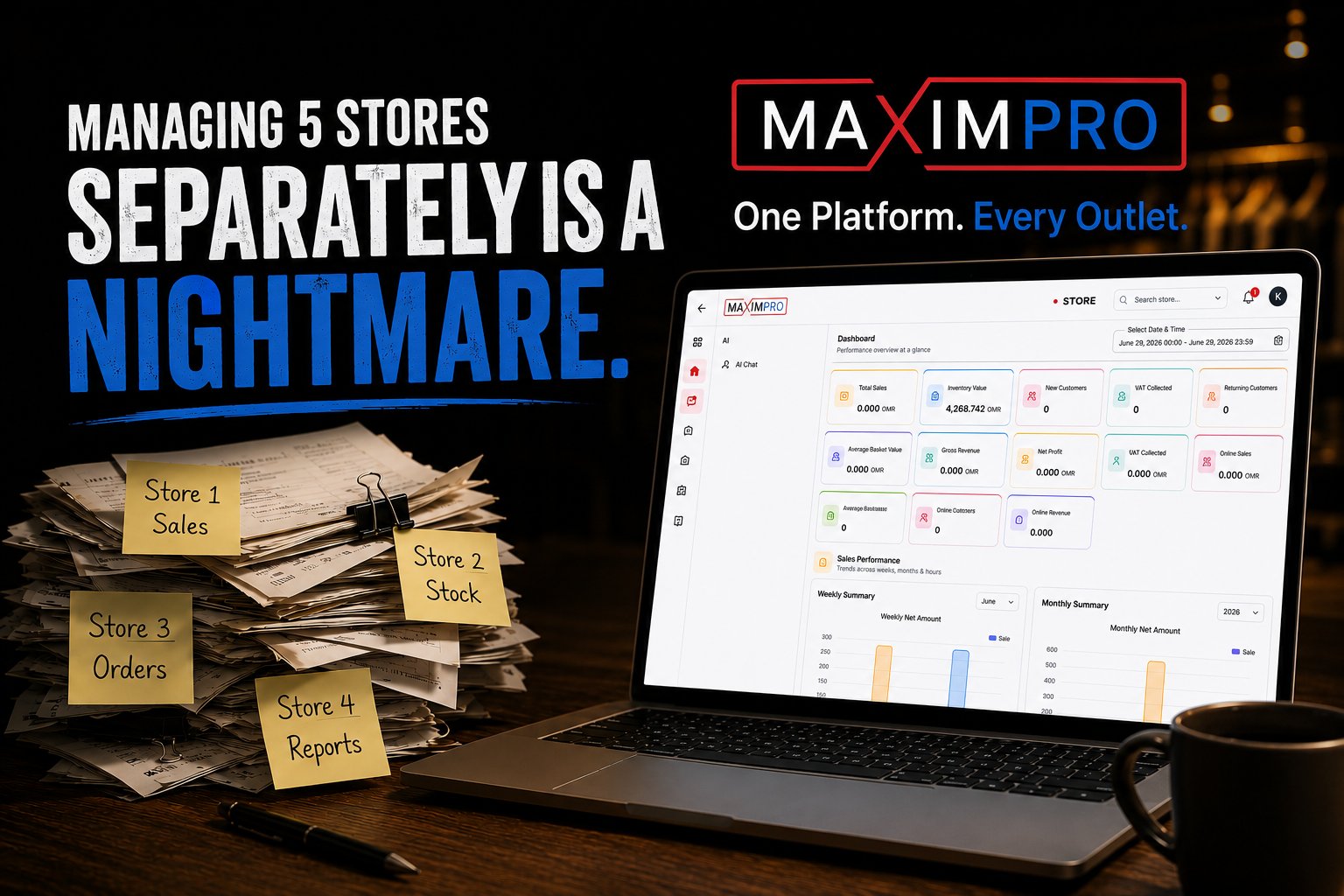
Most multi-outlet retail businesses hit the same wall somewhere between their second and fifth store. The first location ran fine. Data was manageable. Stock was visible. Then came the second outlet — a separate billing system, a separate spreadsheet, a WhatsApp group for restock requests. By the fourth store, the owner is spending two hours every evening piecing together the day’s sales across four separate files, calling store managers about inventory discrepancies, and manually pushing price changes that still haven’t reached every location by morning. That is the problem retail chain management software is designed to eliminate.
This guide explains what the category does, what separates a proper chain management platform from a standard POS, why the software choice carries extra weight in Oman and across the GCC, and what to look for before you commit to a system.
What Is Retail Chain Management Software?
Retail chain management software is a centralized platform that connects the billing, inventory, reporting, and financial operations of every outlet in a chain into a single operating system. Instead of managing each store independently — different files, different systems, different snapshots — the entire chain runs from one dashboard, with live data from every location.
The gap it fills is not small. A retailer with four outlets and no chain management platform typically has four separate end-of-day reports that someone has to manually consolidate. Stock at Outlet 2 might be running critically low, but nobody at Outlet 1 or the head office knows until a phone call or an out-of-stock event triggers the alert. A promotional price change pushed from head office relies on a manager at each location to update it manually — and in practice, at least one outlet misses it.
Chain management software replaces all of that coordination overhead with automation. One master product catalogue. Real-time inventory visible across every location. Pricing and promotions pushed from one screen to all outlets simultaneously. Sales, P&L, and staff performance consolidated by the system — not assembled by a person.
Any retailer operating two or more physical outlets needs this — and any single-outlet operator planning to expand should factor it into their platform choice before they open the second store, because migrating mid-growth is significantly harder than starting right.
The Core Problem — Managing Outlets in Isolation
Data silos are the most visible symptom. Each store’s sales live in its own system, its own format, sometimes on a local machine that requires a physical visit to extract. Consolidating this into anything useful — a weekly sales summary, a chain-wide P&L, a stock variance report — takes manual effort that scales badly as outlets are added.
Inventory blindness is the expensive one. A manager at Outlet 3 places a supplier order for 50 units of a SKU that is sitting as dead stock at Outlet 1. A stock transfer would have cost nothing. The supplier order costs the working capital and the storage space. This happens constantly in chains that have no live cross-outlet inventory visibility — and the aggregate cost across a year across a chain is substantial. Industry estimates put global inventory distortion (overstock, stockouts, misplacement) at approximately $1.73 trillion annually. A meaningful share of that is attributable to exactly this kind of information gap between locations in the same chain.
Pricing inconsistency is a quieter problem but creates direct customer trust damage. A promotion running at three of four outlets, with the fourth still showing the old price, creates confusion at the point of sale and friction for the customer who has already seen the promotional price elsewhere. Manual price-update workflows do not scale reliably.
Shrinkage is the hardest to track without cross-store exception reporting. Variance between theoretical and actual stock at any outlet is normal at some level. But when that variance is systematic at one location, it signals a problem — theft, admin error, supplier short-deliveries, or process failure. Without a platform that compares outlet-by-outlet shrinkage patterns, that signal is buried in the noise.
What Retail Chain Management Software Should Actually Do
There is a version of this category that is feature-heavy on paper and underwhelming in practice. These are the capabilities that genuinely move the needle for a multi-outlet retail chain:
- Centralized product catalogue. One master SKU list that propagates to every outlet. Add a product, update a price, change a barcode — and it applies chain-wide. No per-outlet manual update, no version control problem between locations.
- Real-time cross-outlet inventory. Every manager and the owner should be able to see stock levels at every location, initiate inter-outlet stock transfers, and receive low-stock alerts — from a single screen. Batch updates or nightly syncs are not sufficient for a chain running busy checkout volumes.
- Multi-store POS with consistent billing. Returns, discounts, loyalty, and payment handling should work the same way across every outlet. Customer experience inconsistency between branches is a chain management failure, not just a training problem.
- Financial accounting that consolidates the chain. A P&L per outlet is useful. A consolidated P&L across the chain — with the ability to compare outlet performance side-by-side — is what actually drives ownership decisions. The accounting module should connect directly to the billing data, not require a separate manual import.
- Role-based access. A cashier needs a billing screen. A store manager needs their outlet’s dashboard. A district manager needs a regional view. The owner needs the full chain. A single access level for all roles is a security and usability problem simultaneously.
- 150+ reports filterable by outlet, region, or chain-wide. The reporting depth is where chain management software earns its value. Sales by SKU, by staff member, by time slot, by outlet, by promotion — with the ability to cross-cut these dimensions — turns the POS data into something you can act on.
- Mobile access to dashboards. An owner visiting a supplier, at a trade meeting, or simply at home at 10 PM should be able to check any outlet’s sales, stock, and staff status from their phone. If the system requires a laptop and a VPN to review the day’s data, it is not meeting a basic modern requirement.
GCC Retail Chains — Why the Software Choice Has Extra Stakes
Choosing retail chain management software in Oman or anywhere in the GCC is not the same decision as making it in a market where the compliance landscape is stable. Several factors make the platform choice significantly higher-stakes here.
VAT compliance is non-negotiable. Oman, UAE, Saudi Arabia, Qatar, and Bahrain all operate VAT regimes with specific invoice format requirements. A platform that generates invoices that do not meet the local authority’s format — even for one outlet — creates a compliance exposure that falls on the retailer, not the software vendor.
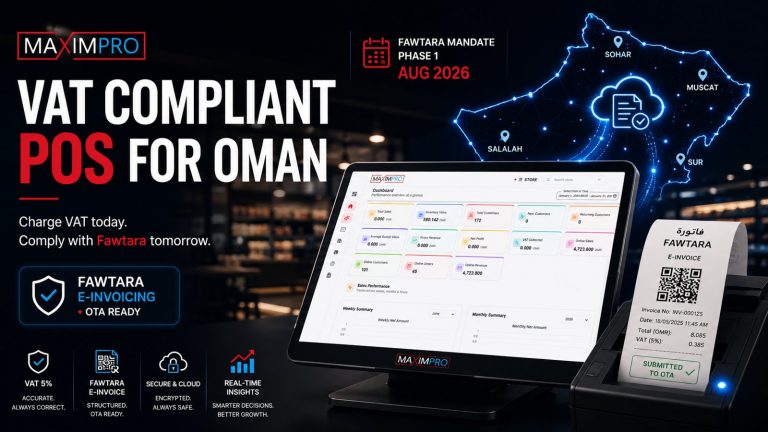
Oman’s Fawtara e-invoicing mandate adds a new layer. The Oman Tax Authority’s Fawtara system follows the PEPPOL 5-corner e-invoicing model. Phase 1 covers the top-100 taxpayers from August 2026, with all VAT-registered businesses projected to be in scope by mid-to-late 2027. Retailers on systems that were not designed for Fawtara will face either an expensive retrofitting project or a forced platform migration during their busiest trading periods. The right time to solve this is now, not when the deadline arrives.
Multi-currency operations are a real requirement for retail chains that span Oman and the UAE. The platform needs to handle OMR and AED natively — not through workarounds or manual conversion.
Arabic-English bilingual interface. Checkout staff operate in Arabic. Owners and finance teams may review reports in English. A system that handles both languages fluently — not through a separate mode — reduces daily friction and training overhead across the chain.
Offline billing capability. Internet connectivity in major GCC cities is generally reliable, but "generally reliable" is not the same as "guaranteed." A POS that stops billing during a connectivity event creates queues, lost sales, and customer frustration. Offline mode with automatic sync on reconnection is a baseline requirement, not a premium feature.
MaximPro — Built Specifically for Multi-Outlet Retail
MaximPro is a cloud-based POS and retail chain management platform built for multi-outlet retail in India and the GCC. VAT compliance, Arabic-English bilingual support, and offline mode are built into the core product — not added as regional modules on a platform designed for a different market.
The module set maps directly to what a chain operator needs:
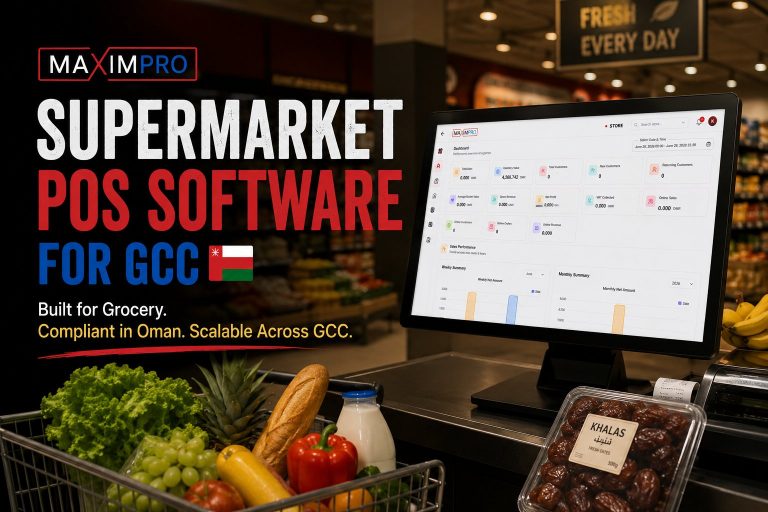
- Turbo POS (Smart Billing). A high-speed billing engine designed for checkout counters processing volume — supermarkets, hypermarkets, busy general retail, and fashion chains. Staff typically reach full operational proficiency within a day.
- Multi-Outlet Inventory and Stock Transfer. Real-time visibility of stock levels at every location. Inter-outlet stock transfers initiated from any screen. Low-stock alerts triggered automatically when levels fall below thresholds you set per SKU per outlet.
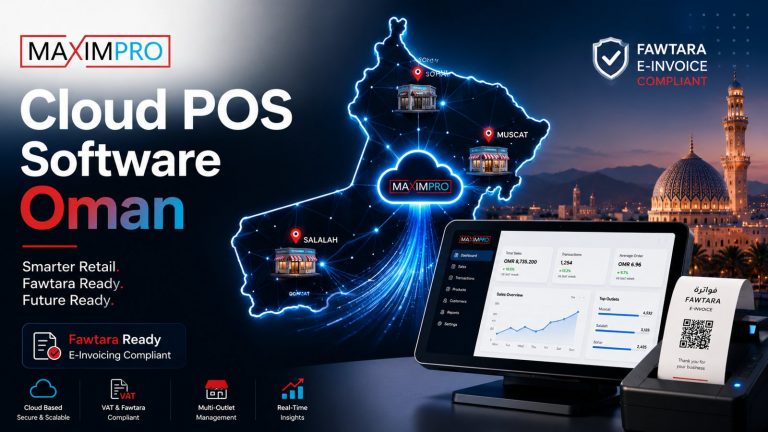
- Multi-Outlet Dashboard. One screen showing every outlet’s sales performance, inventory status, and staff activity. The owner or district manager does not need to log into separate accounts per store — the chain view is the default.
- Financial Accounting. P&L, balance sheet, and cash-flow reporting built into the platform. Per-outlet breakdowns and consolidated chain summaries are generated from the same data — no manual import from the POS into a separate accounting tool.
- Mobile Reports. Full sales and inventory dashboards on mobile. Designed for the reality of a retail chain owner who is not always in a store.
- Mobile WebStore. A connected digital channel for retailers who want to extend their chain into online sales, managed through the same product catalogue and inventory system.
- AI-powered demand forecasting. Sales prediction at the SKU and outlet level to reduce overstock and stockouts. The system identifies demand patterns that are not visible in a manual review of sales data.
For chains where shrinkage is a material P&L concern, MaximPro integrates with AI video surveillance for retail chains through VIZO361, Proeffico’s AI video analytics platform. This integration connects POS transaction data with camera-based cash-theft detection and shoplifting alerts — so a discrepancy flagged at the POS can be cross-referenced with the camera feed from the same time and location. For a grocery chain or a fashion retailer where shrinkage runs above acceptable norms at one outlet, this closes the gap between billing data and in-store behaviour.
Pricing is per outlet: Lite at $80/month, Pro at $100/month, and Enterprise at $130/month. There is no large upfront server hardware investment — the platform is cloud-based, and a new outlet is added through configuration rather than hardware procurement. For details on what each tier includes, see the MaximPro cloud billing platform overview.
Retail Chain Management Software vs. Standard POS — Key Differences
These categories are genuinely different in scope, and the distinction matters when evaluating vendors.
Standard POS manages one location’s transactions. It bills customers, logs sales, handles returns, and may provide basic reports. It does exactly what it was designed to do — for one store. When a second outlet opens, you get a second independent system. The chain management problem is not solved; it is doubled.
Retail chain management software manages the business behind all locations. Centralized inventory, unified pricing, consolidated financials, cross-outlet reporting. The POS is one component — the billing interface at the checkout counter — but it sits inside a broader operating system that keeps the entire chain in sync.
ERP systems go further still — HR, manufacturing, procurement, supply chain, and finance at an enterprise scale. For a 10-outlet retail chain, ERP is typically the wrong answer: the implementation timeline, the cost, and the operational complexity are sized for businesses three to five times larger. A retail chain that commits to a full ERP project before they have the internal capacity to run it usually spends more time managing the ERP implementation than running their stores.
MaximPro occupies the right-sized position: full chain management capability — from POS to consolidated P&L to AI demand forecasting — without the implementation overhead or the cost structure of ERP. It also connects to the MaximPro for hypermarket and grocery chains module set for retailers in those segments specifically.
How to Evaluate and Switch — 5 Questions to Ask Before Buying
These five questions will separate a platform that fits your operation from one that looks right in a demo and causes problems in month three.
- Does it handle our country’s tax compliance natively? For GCC retailers, this means VAT invoice generation built into the billing flow and a credible plan for Fawtara compliance in Oman. "We have a partner for that" is not the same answer as "it is built in." Ask for a live demo of the VAT invoice output and the OTA submission workflow.
- Can we migrate our existing product and customer data without rebuilding from scratch? A product catalogue migration for a chain with thousands of SKUs is not a minor task. Ask the vendor what the migration process looks like for your data structure, and get a realistic timeline from their implementation team — not the sales team.
- What happens when a store loses internet connectivity? Ask to see the offline mode in the demo, not just hear about it. What does the cashier screen look like? Does it process all transaction types? How long after reconnection does the sync complete?
- How long does onboarding take for each new outlet? If adding a new outlet requires a week of implementation work, your expansion pace is constrained by the vendor’s schedule. The answer should be hours to days — not weeks — once the initial platform configuration is established.
- Is there local support in your market? Software support for a retail operation in Muscat that runs on a vendor’s European or North American time zone is support in theory only. Confirm that support hours, language, and response time are appropriate for your operating environment.
Frequently Asked Questions
What is the difference between a POS system and retail chain management software?
A POS system manages transactions at one location — billing, basic stock tracking, and day-end reports for a single store. Retail chain management software manages the entire chain: inventory, pricing, consolidated financials, and reporting across all outlets, with the POS as one component of a broader platform. See our cloud POS in Oman guide for a closer look at what the POS layer should include.
How much does retail chain management software cost?
It varies by platform and outlet count. MaximPro’s per-outlet pricing is $80/month (Lite), $100/month (Pro), or $130/month (Enterprise). A 5-outlet chain on the Pro tier is $500/month with no upfront server hardware cost and no per-transaction fee. Enterprise-grade ERP systems cost multiples of this and carry significant implementation fees on top of the licence.
Can MaximPro manage outlets in multiple countries?
Yes. MaximPro is built for multi-country GCC operations, with support for multiple VAT regimes and multi-currency billing. Retailers spanning Oman and the UAE can manage both markets — with their separate TRN assignments and invoice-field rules — from one platform and one consolidated dashboard.
Does retail chain management software work offline?
MaximPro has an offline billing mode. If a store loses internet connectivity, the POS continues to bill normally. Transaction data syncs back to the cloud automatically when the connection is restored — the checkout counter does not stop because of a network event.
When should a retailer switch from a standard POS to chain management software?
The practical trigger is the second or third outlet — the point at which manual stock reconciliation, separate end-of-day reports, and per-outlet price updates become a daily burden. Waiting until the fourth or fifth store makes the migration harder and means several months of compounding data-gap costs. Any retailer with active expansion plans should evaluate chain management software before opening the next location, not after.
See Every Outlet on One Screen
A retail chain that is still managing its stores through separate billing systems, spreadsheet reconciliation, and WhatsApp restock requests is not just inefficient — it is making decisions on data that is always incomplete and always delayed. The margin impact of that information gap compounds with every outlet added.
MaximPro is built specifically for this problem. Multi-outlet dashboard, real-time inventory, VAT-compliant billing, consolidated financials, AI demand forecasting, and a direct integration with VIZO361 for shrinkage detection — on one platform, priced per outlet, with no server infrastructure requirement.
Book a 30-minute MaximPro demo and tell us your outlet count, store type, and market. We will build the demo session around your actual operation — not a generic walkthrough.