
How to Apply AI in Your Business: An Ultimate Guide for Retailers and More
Operating a business without considering AI is the same as operating a store without a system to process bills—it can be done, but why on earth would it be? Today, artificial intelligence is not some nice-to-have. It is a real competitive edge, and businesses that figured out how to apply AI in business are gaining an advantage already.
However, the sad truth is that the reason why most businesses do not succeed in applying AI is that they do not have a proper strategy in place. Businesses purchase software, conduct tests, run into trouble, and drop the idea altogether. We are going to show you how not to become one of these businesses.
Regardless of whether your business consists of a single retail location or an entire network of stores, our AI implementation guide is sure to come in handy for you.
Before diving into the how, it helps to understand the why.
AI is not magic. It is pattern recognition at scale. It looks at data you already have — sales, customer behavior, inventory movement, staff scheduling — and tells you things that would take a human weeks to figure out. For retail businesses especially, that kind of insight is the difference between over-ordering stock and selling out at exactly the right time.
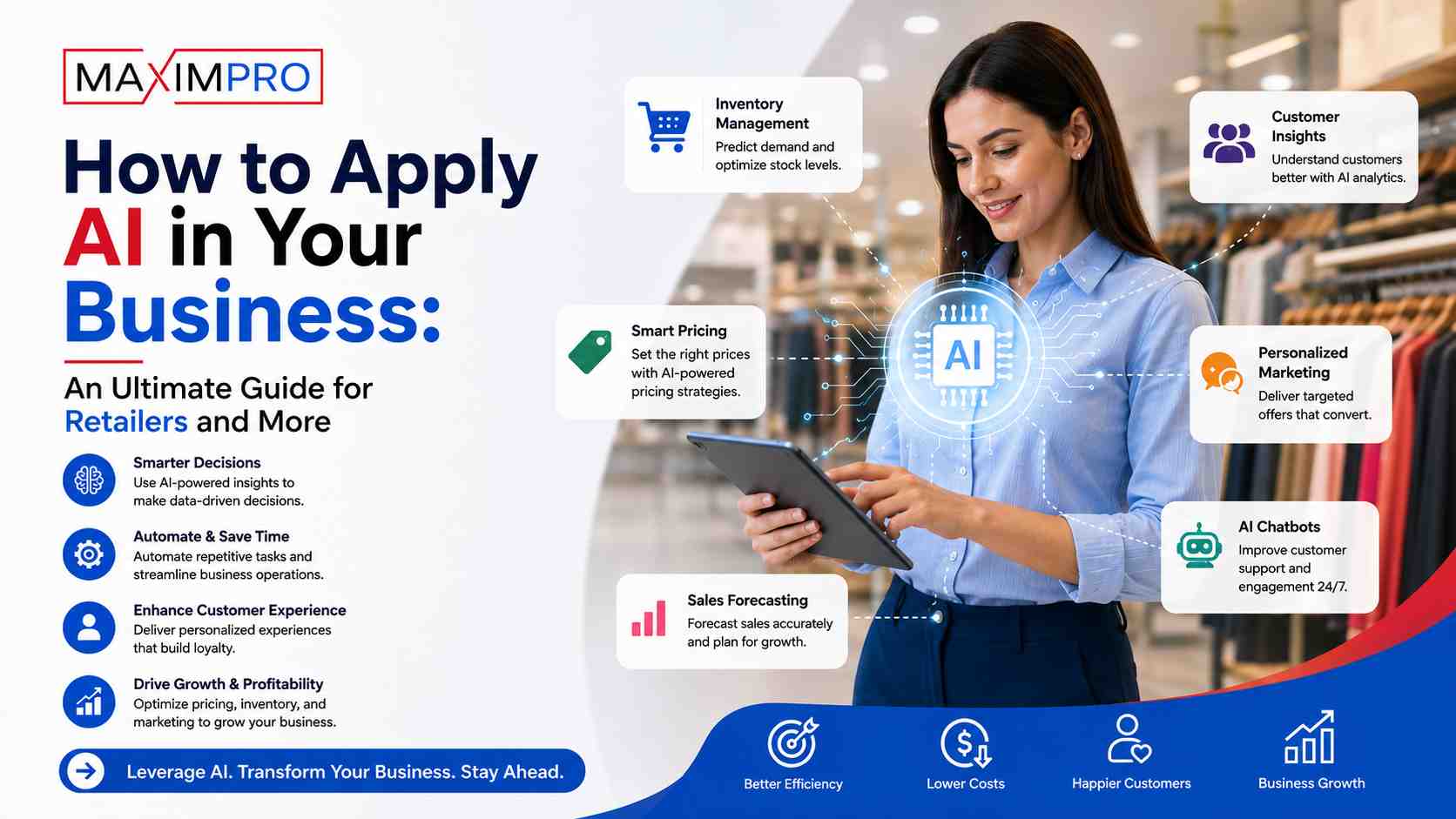
AI integration for companies today covers a wide range:
- Demand forecasting—predicting what will sell, when, and how much
- Customer personalization– recommending products based on purchase history
- Inventory automation– reordering stock without manual intervention
- Staff optimization– scheduling based on predicted footfall
- Fraud detection—flagging suspicious transactions in real time
A cloud-based retail POS platform like MaximPro, for example, is already capturing the transactional data that makes all of this possible. The AI implementation process is really about unlocking the intelligence already sitting in your system.
Step 1: Identify the Business Problem First
The most common mistake businesses commit is identifying an AI technology before defining the business problem.
Answer these questions first before you even begin evaluating any vendor:
- What is currently holding us back?
- Where is there clear loss of profit that we cannot solve?
- What are some of the decision-making tasks that could be aided by data?
For example, a retail firm may want to solve the problem: “We run out of our top-performing products every weekend, and we don’t know why.” This is a problem of demand forecasting. Yes, AI technology can solve the problem but only after identifying the problem clearly.
Pinpoint your main two or three problems to create the base of your business AI strategy.
Step 2: Audit Your Data
Artificial intelligence works on data. Lack of data means a lack of intelligence.
Before embarking on any AI journey, one should first understand what kind of data one has and how suitable that data is for analysis. For a retailer, the list looks something like this:
- Transaction data (what products were sold, when they were sold, at what price)
- Client data (who was buying, how many times, what did he/she return)
- Inventory data (what products were received, what were sold, wasted)
If the POS solution keeps track of transactions for two or more years already, the company is on a good way. Today’s software solutions like MaximPro keep such data automatically and make it available in structured format, just as artificial intelligence models require.
Otherwise, cleaning up data is always better than spending resources on tools that won’t be useful without good quality data. “Garbage in, garbage out” is not a phrase; it’s a rule.
Step 3: Start Small, Prove Value, Then Scale
The key to successful business AI is not through revolution but rather through small wins that can be proved.
Choose one issue raised in Step 1 and identify one AI solution or tool that helps resolve this issue. Roll out this solution only to a specific part of the business, whether one branch, one type of product, or one particular department. Track its impact in relation to a specific baseline figure.
Example: Apply an AI-based forecast of demand for your top 20 products within one quarter and compare their stockout rate and overstock level to last quarter. If there is an improvement, apply it to the rest of your products.
This way of doing things is referred to as the “pilot first” approach, which reduces risks and increases belief in the usefulness of AI.
Step 4: Choose the Right Tools for Your Stack
There is no requirement for constructing your own AI technology. In most cases involving retail organizations, the correct solution involves using tools that are infused with AI functionality.
As an initial step when considering the adoption of a tool, you should be asking questions such as:
- Does it work with my existing POS software?
- Do I require data scientists to implement it, or will it work with my operations team?
- What type of support is there for onboarding?
- What kinds of AI capabilities does it offer? Which of them is relevant to my organization?
Given MaximPro’s nature as a cloud-based retail POS software, it integrates seamlessly with advanced AI functions. This is made possible by the fact that the system is already generating valuable data about sales, inventory, and customers, all of which constitute a data layer available for integration with AI solutions.
Step 5: Train Your Team
The problem isn’t that technology transforms business—it’s that people transform business.
Most commonly, AI implementation fails not due to malfunctions within the system itself but rather because of human resistance or lack of knowledge regarding how the system works. An example would be a sales manager that does not understand the basis behind the AI suggestion for reordering; a cashier that doesn’t know why the AI suggested a loyalty offer onscreen.
Train your employees. Make it as clear-cut as possible:
Explain to them what the AI is doing, and why
How exactly their job will change thanks to the introduction of AI
Set up a feedback mechanism, so your employees can tell you if anything is off
AI is supposed to streamline their work—present this perspective.
Step 6: Measure, Iterate, and Expand
After you get your pilot off the ground and your people on board, establish a rhythm of review.
Choose KPIs for yourself prior to launch – such things as frequency of stockouts, average order size, customer return ratio, or shrinkage. Check in monthly. If AI is working, grow its reach. If not, investigate reasons and grow it cautiously.
Transformation by means of AI should not be treated as a project but rather as a continuously evolving capability that benefits from increasing amounts of data going through the system. The companies that will succeed in this process are those treating AI as an investment and not just another deployment.
Common Pitfalls to Avoid
Yet despite a sound strategy, firms will still make mistakes. These are the top errors:
- Using AI without upper management approval – In case executives do not embrace the idea, funding will be reduced and the project will fail.
- Going for a complex solution – Just because enterprise-level AI technologies are costly does not mean they should be chosen; opt for solutions that match your requirements and the skills of your workforce.
- Ignoring customer data privacy – Using customer data as a basis for AI models necessitates proper protection of this data as dictated by relevant legislation.
- Creating unrealistically short deadlines—significant AI integration will take between six to eighteen months.
Conclusion
Integrating AI into your business is not merely riding on a wave of popularity. Instead, it means making better and faster decisions—and sustaining this process over time.
There are common denominators among those who succeed in deploying AI solutions—starting off with a proper pain point, using quality data, proving ROI through gradual implementation, and involving people throughout the process. Deploying AI for enterprises is not so much a technological issue as an organizational one.
From the standpoint of retailers, another piece of good news is that necessary data architecture is already in place. Software solutions like MaximPro generate all of the necessary transactional and behavioral data, which allows for AI to be implemented successfully. Our tips on integrating AI into a company are not some abstract recommendations; they come from our practice of successful deployment.
The best moment to embark on your journey was two years ago. The second best moment – is today. Choose your initial problem, conduct your pilot, and scale up from there. The competitive advantage of companies that implement AI successfully versus companies that fail at implementing AI will grow significantly in the coming months and years—and you can influence this advantage.
FAQs – How to Apply AI in Your Business
1. What are the first steps to applying AI in a business?
Start by identifying repetitive tasks, customer pain points, or areas where data analysis is needed. Businesses commonly begin with AI-powered chatbots, automation tools, predictive analytics, or customer support systems.
2. How can MaximPro help businesses implement AI solutions?
MaximPro provides AI-powered business solutions that help retailers and enterprises automate operations, improve customer experience, manage inventory, and increase overall business efficiency.
3. What AI features does MaximPro offer for retailers?
MaximPro offers smart inventory management, AI-based analytics, automated billing, customer insights, cloud reporting, and retail automation tools designed to improve store performance and sales.
4. Is MaximPro suitable for small and medium-sized businesses?
Yes, MaximPro provides scalable AI solutions for startups, SMEs, supermarkets, hypermarkets, and enterprise retail businesses with flexible implementation options.
5. Why should businesses choose MaximPro for AI implementation?
Businesses choose MaximPro because of its industry-focused retail technology, AI-driven automation, cloud-based solutions, and ability to customize systems according to specific business needs.